Back
Sodium-Ion vs. Lithium-Ion: What Comparative Cycling and Mechanical Stability Analysis Reveals
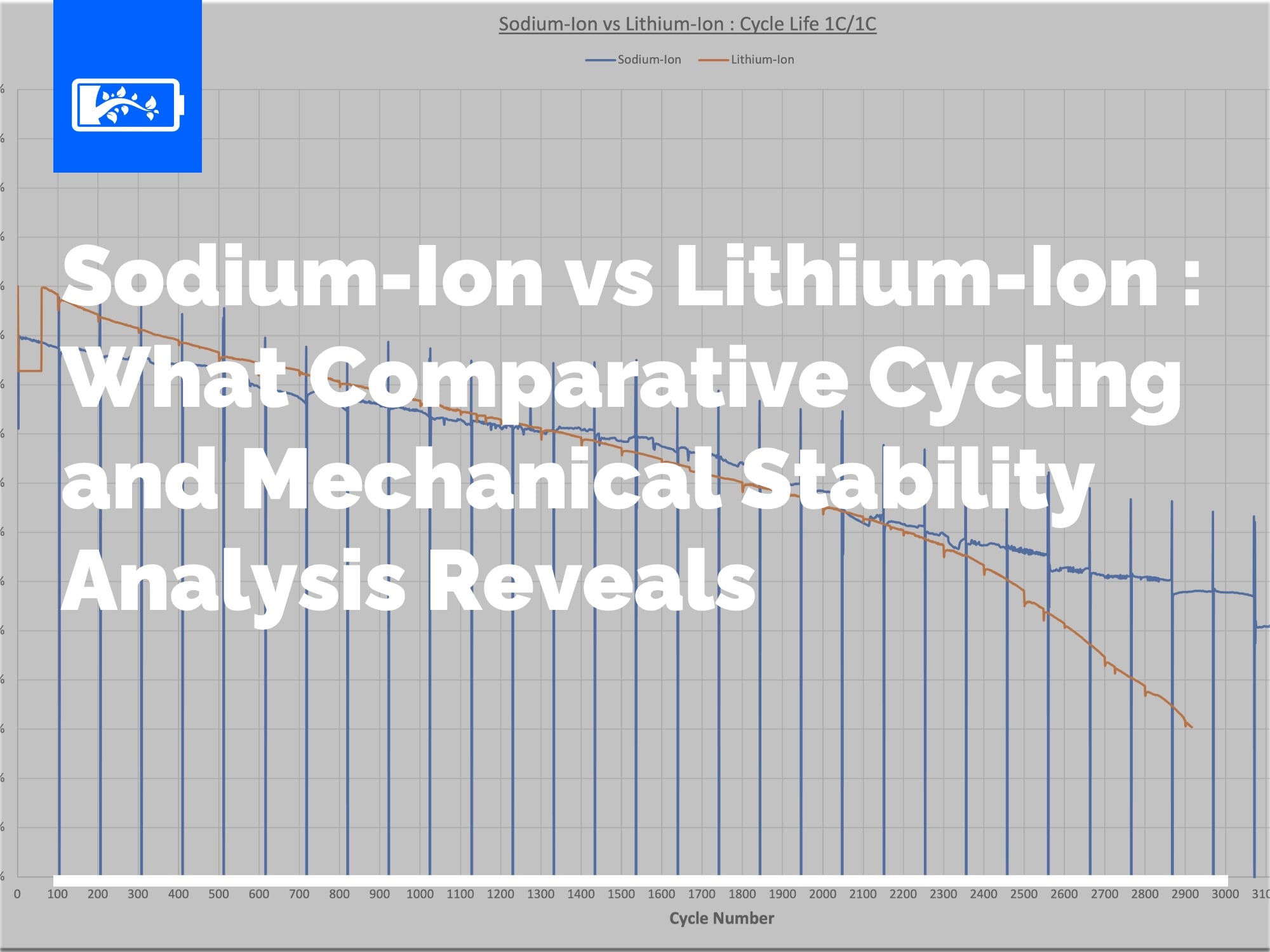
When comparing Sodium-Ion technology to Lithium-Ion chemistries, discussions too often focus solely on energy density. However, for a system integrator or pack designer, cyclability, stability, and durability define a system's true value.
Our internal test bench campaigns highlight three fundamental operational differences.
Where Lithium-Ion chemistries suffer degradation over cycles, Sodium-Ion demonstrates significantly lower capacity loss.
Lithium-Ion: Our tests measure an average capacity loss of approximately 10% after 1,500 cycles.
Sodium-Ion: Under identical conditions, measured capacity loss stands at only about 5%.
This two-fold reduction in degradation per cycle guarantees a substantially longer operating lifespan for your systems.
End-of-life cell swelling is one of the primary engineering challenges when integrating Lithium-Ion cells. A swelling cell exerts severe mechanical stress on the pack casing and structure, requiring large tolerance margins.
Lithium-Ion: We regularly observe swelling reaching up to 2 cm per cell face at end-of-life.
Sodium-Ion: Across all our cycling campaigns, no swelling was observed at the conclusion of our tests.
This dimensional stability simplifies module mechanical design and eliminates the risk of internal crushing or structural deformation within the pack.
Subjected to laboratory endurance testing at 25°C, Sodium-Ion exhibits remarkable chemical resistance to aging.
Projections derived from our test benches estimate a lifespan of at least 10,000 cycles.
In practical application terms:
1 cycle per day: An estimated operational lifespan of 27 years (1C/1C, continuous, 100% DoD).
2 cycles per day: A projected durability of 13.5 years (1C/1C, continuous, 100% DoD).
A comparison highlighting only advantages would be of no value for engineering decisions. Sodium-Ion comes with real trade-offs that, for many applications, remain deal-breakers:
Lower Energy Density: For equivalent energy capacity, a Sodium-Ion pack is heavier and more voluminous. In any weight- or space-constrained application, this penalty outweighs the benefits listed above.
Lower Nominal Voltage: Reaching a given bus voltage requires more cells in series, increasing the number of BMS monitoring channels, wiring complexity, and potential failure points.
Limited Industrial Supply Chain: Qualified supply sources are few, field track records are brief, and multi-sourcing—common practice in Lithium—remains difficult to implement.
Raw Material Advantage Not Yet Reflected in Price: Sodium abundance is a long-term strategic argument; at current production volumes, it does not automatically translate into a lower cost per kWh.
Conversely, two advantages of Sodium-Ion extend beyond our cycling tests and warrant consideration: superior performance retention at low temperatures, and the ability to be transported and stored at 0 V, which simplifies logistics and reduces risks associated with long-term storage.
At SIG Energy Technology, we do more than test cells: we design tailored module architectures to enable integrators to safely unlock the full potential of Sodium-Ion technology.
These measurements confirm the strategic potential of Sodium-Ion: a chemistry that outperforms Lithium-Ion in long-term chemical stability and lifespan, delivering a durable and highly predictable storage solution.
To receive our complete Sodium benchmark report, contact us at info@sig-innotech.com.