Back
Sodium-Ion Technology Integration: Our Modules Ready for Next-Generation Storage
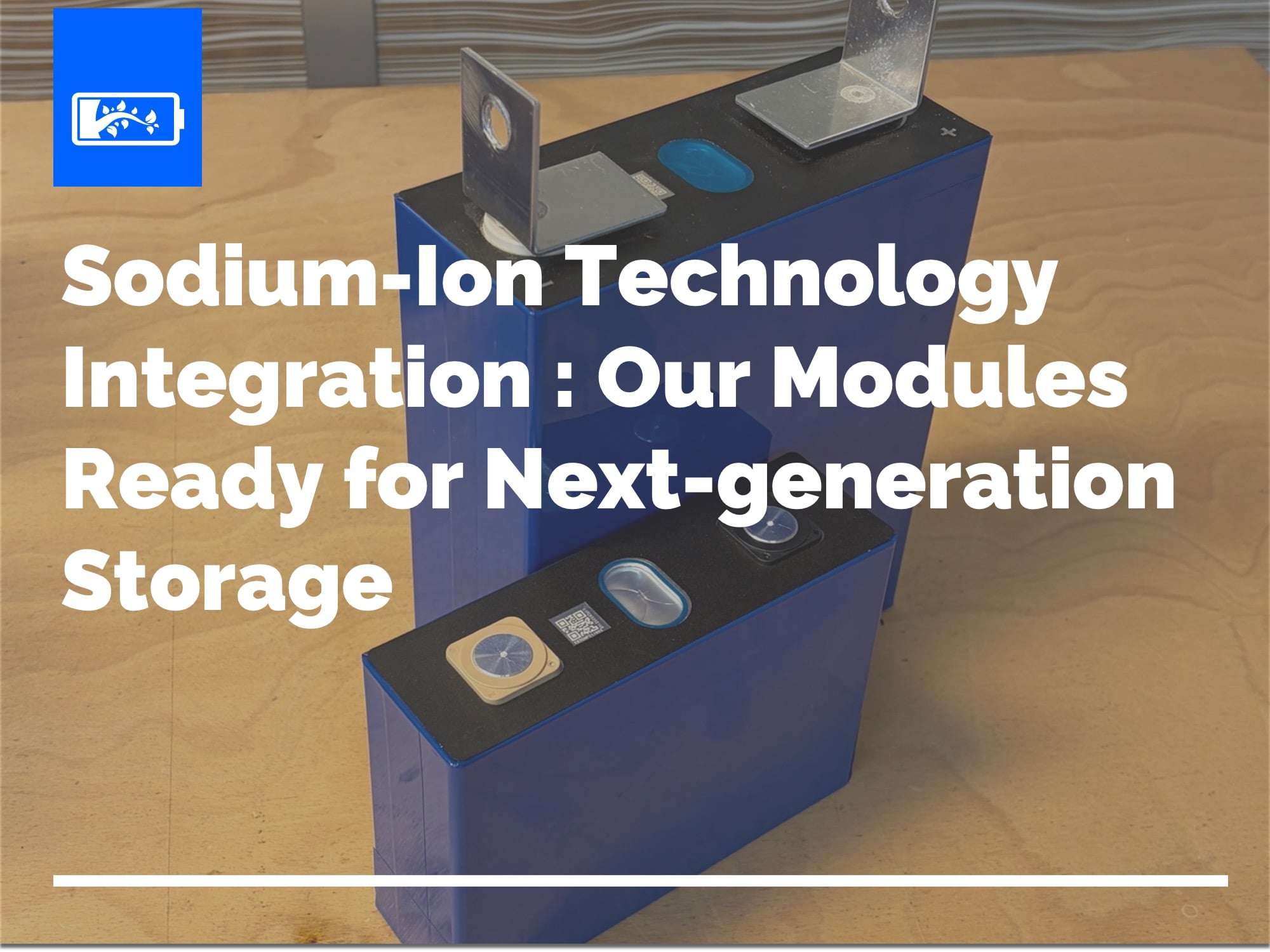
We conducted an extensive benchmark campaign on Sodium-Ion cells using our own test benches. One key result sets the tone: one of the tested cells retains 108% of its initial capacity after 1,600 cycles.
The campaign evaluated several references from different suppliers through long-term cycling, internal resistance measurement (DCIR), and temperature testing. These tests were carried out in-house, on our benches, using our own holders, not copied from supplier datasheets.
One point deserves clarification, as it conditions the entire integration process: like any prismatic cell, a Sodium-Ion cell must be kept under controlled compression within the range specified by the manufacturer. This is not unique to this chemistry; it is a requirement we already manage on our LFP modules. What changes, however, are the dimensions: integrating a new reference means adapting the hold geometry, not just swapping out the cells.
Our modules rely on an intercalary system that provides controlled, constant compression throughout their lifespan. That is precisely what Sodium-Ion demands, and it allows us to accommodate this chemistry without redesigning the architecture.
Our modules remain repairable and dismountable. On an emerging technology, this is not a minor maintenance detail: it dictates the risk taken by the integrator. Cells can be replaced, including by a future generation, while the module structure itself does not become obsolete. A welded module offers no such buffer.
• Transport and storage at 0 V: Sodium-Ion supports full discharge without damage. This makes a tangible difference in logistics, long-term storage, and on-site risk management.
• Independence from lithium and cobalt: Sodium is abundant and widely distributed. For an integrator, this means reduced exposure to the supply chain bottlenecks currently weighing on lithium lines.
• In packs: direct assembly of our modules for compact stationary or mobility applications.
• In racks and BESS cabinets: streamlined standardization for easy integration into scaled storage architectures.
Our Sodium-Ion benchmark report (test protocols, cycling curves, DCIR and temperature measurements, reference comparisons) is available upon request.
Contact us by email to receive your copy or to discuss integrating Sodium-Ion modules into your upcoming projects.