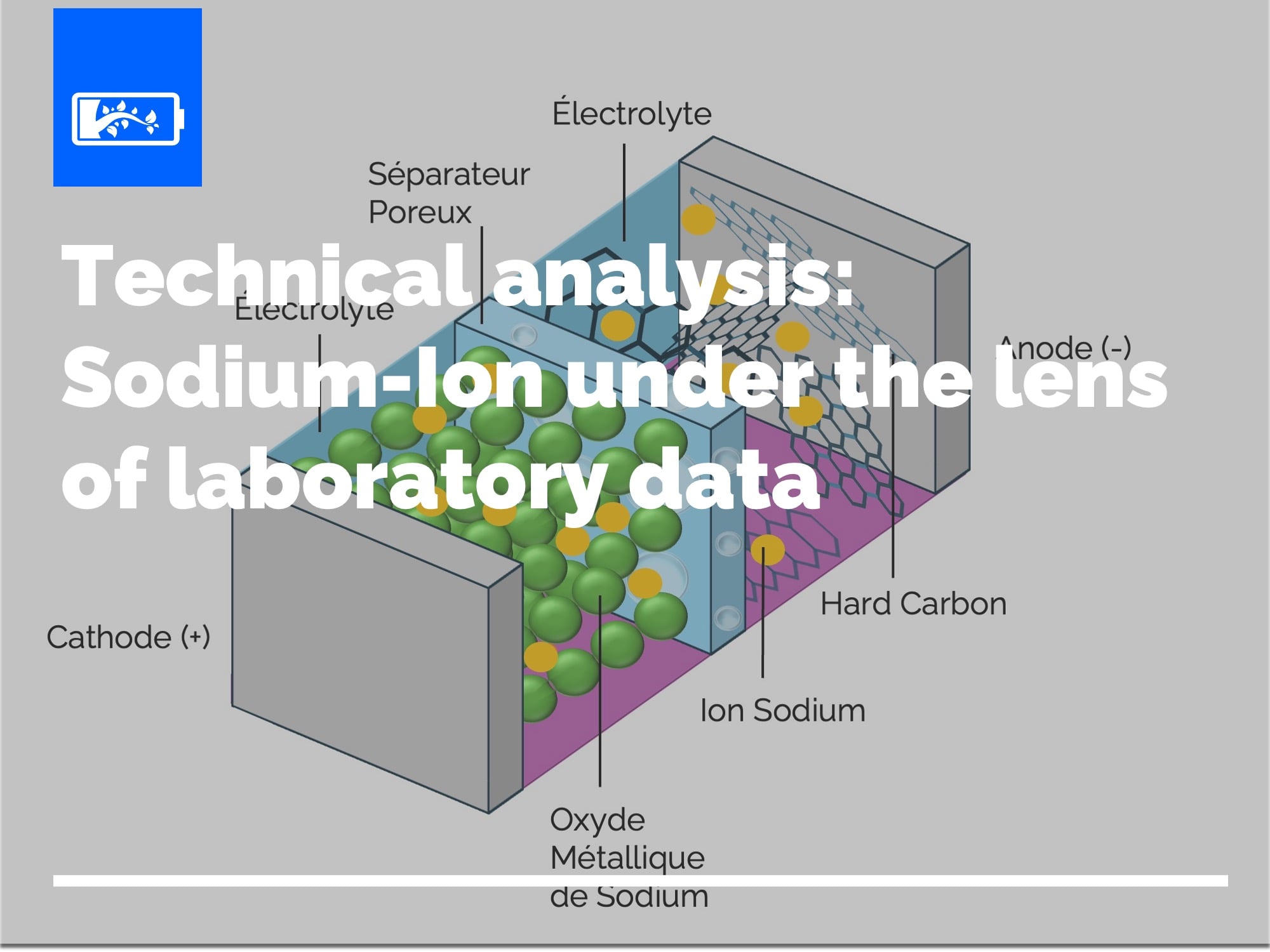
The current battery market highlights three major technologies with distinct characteristics: Lithium-Ion, the dominant market reference; Semi-solid, which drastically reduces the amount of liquid electrolyte to maximize safety, and Sodium-Ion, which is emerging as a strategic alternative due to the raw material availability.
However, Sodium-Ion technology is not monolithic and features several cathode chemistries with distinct behaviors. To assist our customers in making technical decisions, SIG Energy Technology has conducted a comprehensive benchmark of Sodium-Ion cells released in 2025, tested and characterized within our laboratory. This testing campaign allows us to analyze the specificities of the two major options currently available on the market: NFPP and NFM.
Our laboratory test results reveal differentiated technical profiles for these two sub-chemistries:
NFPP (Iron Pyrophosphate): This chemistry relies on a polyanionic structure offering exceptional thermal stability and a long cycle life.
NFM (Layered Oxide): This variant stands out for its higher energy density, which is closer to current market standards.
Our benchmark highlights three key decision-making pillars for system designers: energy density, cycle life, and voltage range.
<head>
    <meta charset="UTF-8">
    <meta name="viewport"
          content="width=device-width,
                   initial-scale=1.0">
    <title>Full Width Table</title>
    <style>
        body, html {
            margin: 0;
            padding: 0;
            width: 100%;
        }

        .container {
            width: 100%;
        }

        table {
            width: 100%;
            border-collapse: collapse;
        }

        th, td {
            border: 1px solid #000;
            padding: 8px;
            text-align: center;
        }

        th {
            background-color: #0068eb;
        }
    </style>
</head>
<table>
	<thead>
  	<tr><th> <p style="color:white;">Chemistry</p></th><th><p style="color:white;">Energy density</th><th><p style="color:white;">Nominal voltage</th><th><p style="color:white;">Voltage range</th>
  </thead>
  <tbody>
  	<tr><td><b>NFPP</b></td><td>~ 95 Wh/kg<br</br></td><td>2.9 V</td><td>1.5 - 3.45 V</td>
    <tr><td><b>NFM</b></td><td>~ 120 Wh/kg<br></td><td>3 V</td><td>1.5 - 3.95 V</td>

   </tbody>
</table>SIG Energy Technology’s commitment is built upon the scientific validation of emerging technologies. Leveraging the data from our Sodium-Ion benchmark helps guide cell selection toward the most suitable solution for the real-world performance, safety, and cost constraints of industrial projects.
For our customers wishing to study this benchmark or analyze the integration of these solutions, please contact us by email.