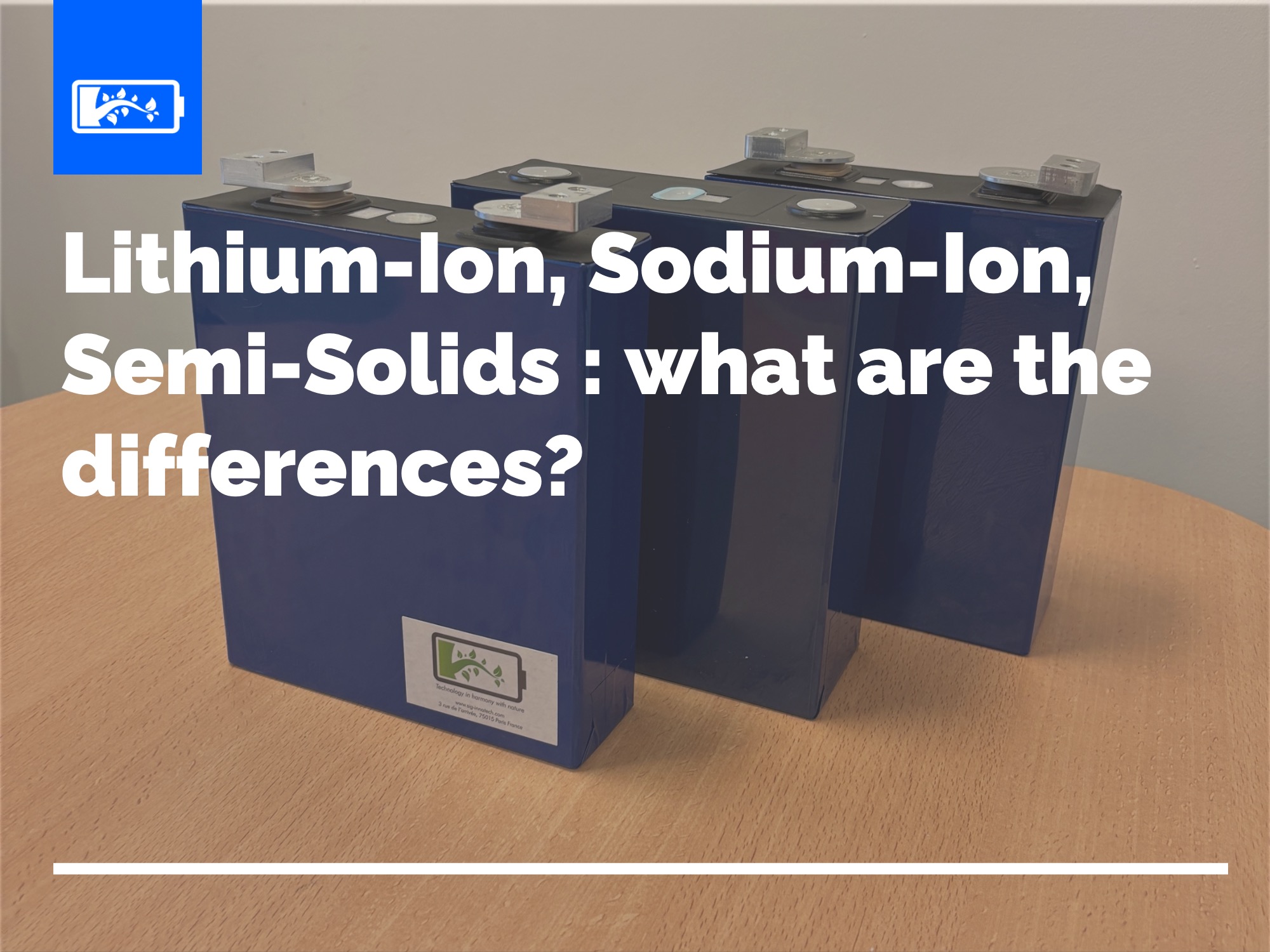
The battery market, still dominated by Lithium-Ion, is seeing the emergence of new chemistries that address new challenges in performance, safety, and material availability.
Lithium-ion is not a single technology. It encompasses various variants that primarily use Lithium, including:
LFP (Lithium Iron Phosphate)
NMC (Nickel Manganese Cobalt)
LTO (Lithium Titanate)
NCA (Nickel Cobalt Aluminum)
LCO (Lithium Cobalt Oxide)
Among the Lithium-ion chemistries, LFP and NMC dominate the market due to their performance and versatility. Here are their main characteristics :
Chemistry | Energy Density | Nominal Voltage | Voltage Range |
|---|---|---|---|
LFP | 160-180 Wh/kg | 3.2 V | 2.5-3.65 V |
NMC | 230-245 Wh/kg | 3.65 V | 2.8-4.25 V |
These differences within the same technology are mainly related to the composition of the cathode, which influences its parameters as well as the safety level of the battery.
Lithium-ion batteries have a classic risk profile :
External short-circuiting is the main danger
There are also internal chemical risks that can cause thermal runaway
These phenomena are related to the presence of a flammable liquid electrolyte, which reacts under certain conditions.
Like Lithium-Ion, Sodium-Ion technology is based on several chemistries, each with specific characteristics.
The choice to use Sodium is based on its abundance, providing potential for long-term cost reduction, even though these cells are currently more expensive than their Lithium-Ion counterparts.
Compared to Lithium-Ion, they are distinguished by:
Lower voltage ranges (1.5 – 4.2 V)
An interesting theoretical specific capacity, particularly for the PBA chemistry (Prussian Blue Analogues, ~170 mAh/g), similar to that of the LFP chemistry (~165 mAh/g)
The possibility of being transported at 0 V (with a risk of passivation during prolonged storage)
A more thermally stable electrolyte (NaPF₆) compared to the one used in Lithium-Ion (LiPF₆), with a decomposition temperature higher by 20 to 30 °C, thus delaying thermal runaway.
Among the sodium-ion technologies already commercialized, we find :
NFPP (Sodium Iron Phosphate Phospho-Oxalate)
NFM (Sodium Iron Manganese)
NVPF (Sodium Vanadium Phosphate Fluoride)
Their main characteristics are :
Chemistry | Energy Density | Nominal Voltage | Voltage Range |
|---|---|---|---|
NFPP | 95 Wh/kg | 2.9 V | 1.5-3.45 V |
NFM | 120 Wh/kg | 3 V | 1.5-3.95 V |
NVPF | 105 Wh/kg | 3.7 V | 2-4.2 V |
These values show that, although less energetic than Lithium-Ion, Sodium-Ion cells pave the way for competitive solutions, particularly in applications where cost, safety, and material availability take precedence over energy density.
In the so-called solid technology, three categories are distinguished: Semi-Solids, Quasi-Solids, and All-Solids, based on the amount of liquid electrolyte used. By a misuse of language, the term All-Solid is often used to refer to all these technologies. However, only the Semi-Solid technology is beginning to be commercialized.
The Semi-Solid technology is based on the same components as Lithium-Ion batteries. The major difference lies in the significant reduction of the liquid electrolyte :
Lithium-Ion : ~25% of total weight
Semi-Solids : 5–10%
Quasi-Solids : <5%
All-Solids : 0%
By decreasing the amount of liquid electrolyte, the risk of thermal runaway is reduced without impacting performance.
Semi-Solid cells thus represent a promising solution for applications where safety is a major concern.
Although the battery market is evolving rapidly, new technologies are emerging today to address significant issues related to performance, safety, and durability. While Lithium-ion remains dominant, other solutions are taking shape.
In addition to Sodium-Ion and Semi-Solid, several other technologies are currently being explored at the laboratory scale, including :
Potassium-Ion (KIB)
Lithium-Sulfur (Li-S)
All-solid
Lithium-Air (Li-O₂)
These innovations, still experimental, could offer significant advantages in the future: enhanced safety, very high energy densities, or improved cycling capabilities. Although they are currently confined to the laboratory stage, they hold substantial potential for the future.
At SIG Energy Technology, we are closely monitoring these developments. We are ready to test these new technologies to anticipate the needs of tomorrow and pave the way for the next generation of batteries.