Back
Cell warranty: what is it worth when you buy direct from outside the EU?
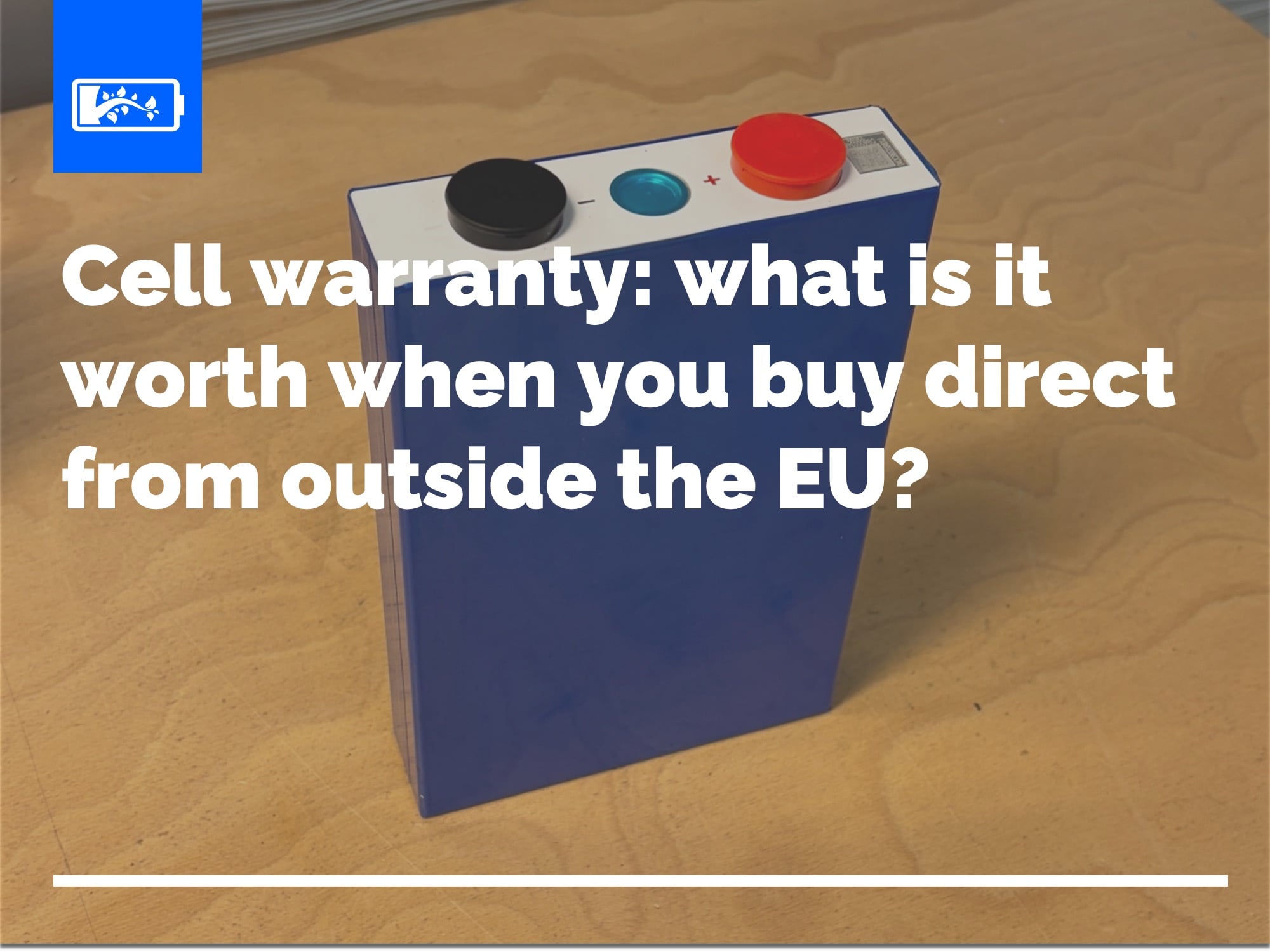
Buying lithium-ion cells direct from outside the EU lowers the unit price, but the warranty on paper is not always one you can actually enforce. Here are the points to check before you sign.
A cell warranty is usually a performance threshold at a given point in time, for example a minimum capacity after a number of years or cycles. Its real scope depends on three elements:
Measurement conditions: temperature, current, cut-off voltages. The warranty threshold only means something under these reference conditions; a measurement taken under other conditions cannot be held against the manufacturer.
Reference capacity: nominal, typical or minimum? The difference alone can be enough to put a cell below the threshold.
Usage exclusions: overcharge, deep discharge, temperature out of range, prolonged storage at high state of charge, non-compliant compression, poorly controlled assembly.
It is therefore up to the buyer to prove these conditions were met: BMS data is part of the case file.
The manufacturer will ask for curves, a measured capacity and an internal resistance, obtained with a method comparable to its own. Without characterisation on receipt, you have no initial state (capacity, DCIR): you cannot prove degradation, or tell it apart from normal batch variation.
Between businesses, consumer statutory warranties do not apply: the contract prevails.
Governing law: often the supplier's, unless negotiated. The UN Convention on Contracts for the International Sale of Goods (CISG) may also apply unless the contract expressly excludes it.
Disputes: a foreign court or international arbitration, with costs out of proportion to a batch of cells.
Limitation of liability: capped at the price of the cells, with indirect damages excluded. The warranty often comes down to a replacement or a credit note, without covering removal or downtime.
When you buy direct, you are also the importer: customs, VAT, compliance and Regulation (EU) 2023/1542.
Point to watch | Direct purchase outside the EU | Purchase through an EU-based partner |
|---|---|---|
Contact in case of defect | Manufacturer abroad | A local contact |
Governing law | Often the supplier's, to be negotiated | Defined by contract, in Europe |
Proof of defect | Your responsibility, with your own test resources | Backed by laboratory data on receipt |
Return of cells | Export, ADR transport, customs | Local ADR-compliant logistics |
Import compliance | Your responsibility | To be clarified with the partner |
Consequential costs | Generally excluded | To be negotiated in the contract |
Have the measurement method used to establish a defect, and the reference capacity, defined in writing.
Negotiate the governing law, dispute resolution and liability cap.
Specify who bears the cost of shipping a defective cell (return, replacement without return, credit note).
Require traceability by batch, ideally by cell.
Test a sample, plan an inspection on receipt and avoid paying in full at order.
We treat the warranty as a matter of data and traceability: cells characterised in our laboratory in France under the manufacturer's reference conditions, inspected on receipt, matched and tracked individually, with local stock delivered within 6 to 10 days in the EU.
Preparing a cell purchase and want to secure your warranty terms? Contact us at info@sig-innotech.com. We can help you define a receiving and validation protocol suited to your project.