Back
Why Battery Cell Capacity Is Scaling Up: The System-Level Math Behind Larger Cells
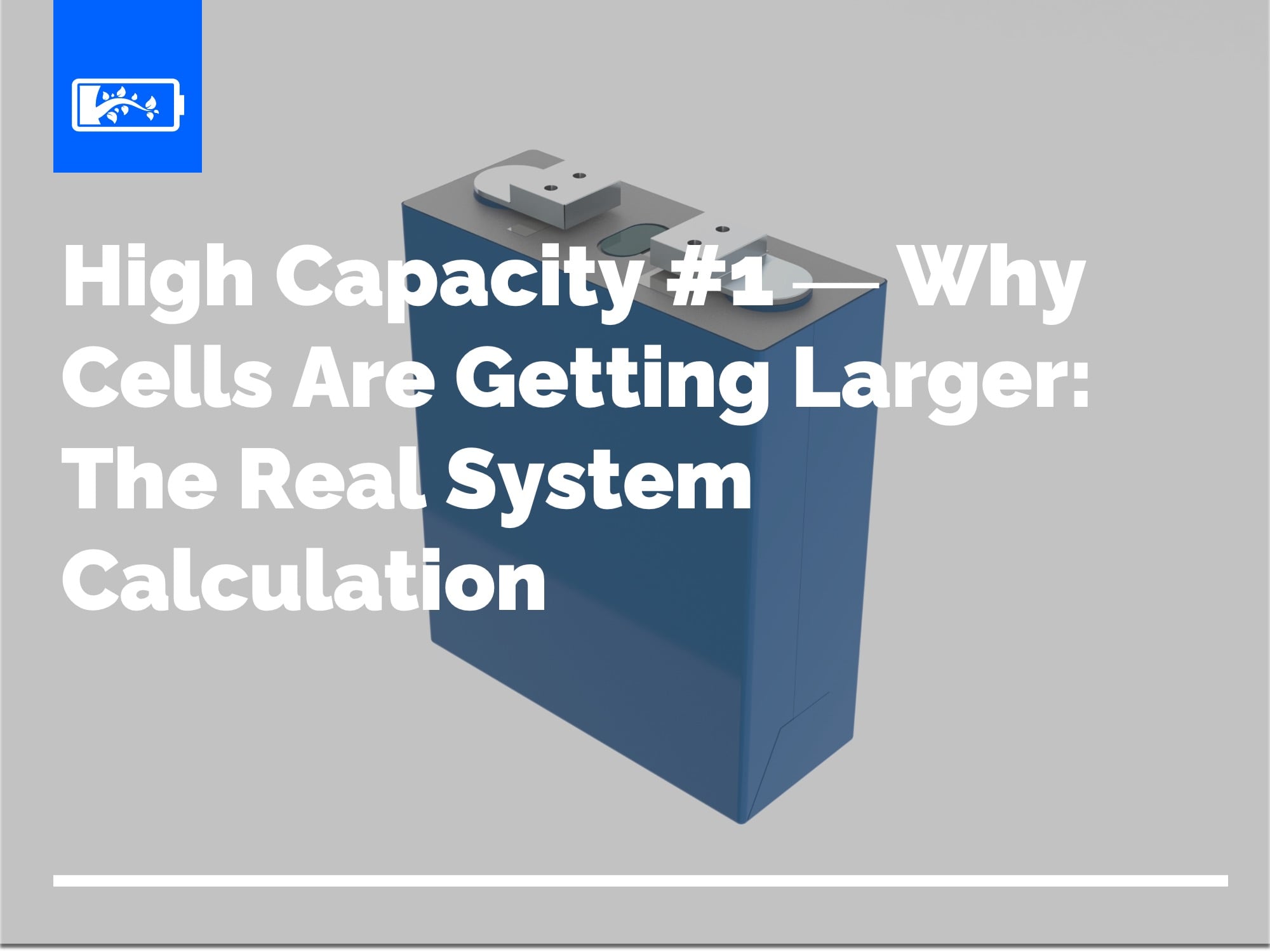
Cell manufacturers are scaling up the capacity of their production lines. The reason has less to do with individual cell performance than with system-level math: for the same amount of energy, fewer cells mean fewer components and fewer interfaces. This article breaks down that calculation and the engineering constraints it introduces.
A cell's energy is the product of its nominal voltage and its capacity. For a 3.2 V LFP cell, this yields roughly 320 Wh at 100 Ah and roughly 1 kWh at 314 Ah. Therefore, a 4 MWh container requires:
approximately 12,500 cells of 100 Ah;
approximately 4,000 cells of 314 Ah.
This 1-to-3 ratio is the starting point. It cascades into almost every other aspect of system design.
For the manufacturer, the logic is identical. The underlying cell chemistry remains unchanged—only the format scales up. For the same delivered energy, there are fewer parts to produce, test, and assemble.
Fewer cells mean fewer components to connect, monitor, and assemble:
Connections: Fewer busbars, welds, or bolted joints, resulting in fewer resistance points and potential points of failure.
BMS: Fewer voltage and temperature sensing channels to wire.
Assembly: Less handling, reduced assembly time, and a simpler mechanical structure.
System-Level Energy Density: Less inactive material (casings, brackets) for the same total energy, directly impacting the cost per kWh.
A prismatic cell's capacity increases by adjusting its physical dimensions (height, thickness, length) alongside the chemistry's energy density. The format then dictates integration: sharing a common footprint across multiple capacities allows integrators to keep the same module and structural design from one variant to the next—which explains the industry's interest in constant-width cell platforms.
Increasing cell capacity shifts the engineering constraints that both manufacturers and integrators must address:
Thermal Management: Volume grows faster than heat-exchange surface area. Heat generated at the core of the cell dissipates less effectively, particularly under high current loads.
Swelling and Compression: Mechanical forces scale with the surface area of the cell faces. Compression architecture and inter-cell pad design become critical.
Energy per Cell: In the event of a fault, the energy contained within a single element is higher, placing heavier demands on safety and protection design.
Granularity: Replacing a faulty cell removes a larger fraction of total system capacity at once.
Handling: Higher unit weight requires dedicated lifting equipment and adapted assembly processes.
Cell Matching: Cell-to-cell variance has a greater impact when fewer cells are configured in parallel.
Start from the application current: A high discharge rate limits the benefit of oversized cells if cooling capacity is constrained.
Verify space and structural limits: The cell's footprint and weight must align with the overall system envelope.
Design compression from day one: Treat it as a core structural parameter, not a post-assembly adjustment.
Validate through lab testing: Capacity, internal resistance, and thermal behavior must be characterized in the lab prior to system integration.
We support cell sizing decisions through laboratory testing in France and module architectures tailored to each specific cell format.
Evaluating different cell formats for your project? Contact us at info@sig-inotech.com—we can compare your options based on your system constraints and our test data.